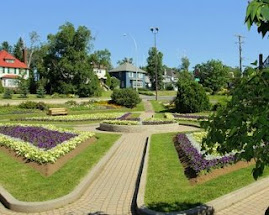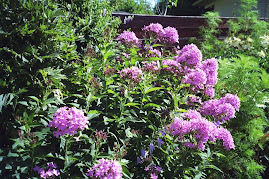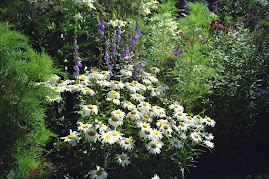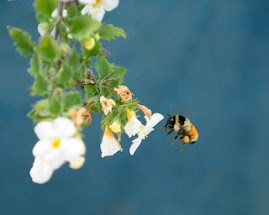
I cannot believe things are still blooming in the gardens around town. Today I was amazed to see a Stella d'oro day lily arrive with a few fat buds ready for the next few days. Stella is not my favourite day lily. It is not very florifierous and it is small. But if I ever fulfil my dream to make a garden room entirely of day lilies and Asiatic lilies, Stella would be there if only because it is tough.
The marigolds are amazing around town. My tiny yellow ones, (a variety called lemon gem grown from seeds fromT&T) may bloom all winter. They pay no intention to the frost at night. I gave away a lot of lemon gem plants which are blooming merrily where ever they were planted. They make balls of small yellow flowers and, in fact, do not look like marigolds at all.
Also hanging around are the bachelor buttons and a few Marie Bugnet roses. Don't these plants know it is almost Hallowe'en?
Is it my imagination or are the leaves also slow to fall this year. I am ready for them. I rake them into a tarp, gather up the corners and toss them on the compost. I also like to get a few clear plastic bags full of leaves to put on the compost as a sort of insulation. They rot a bit inside the plastic. In spring I use them to layer up with greener compost material.
I will spread compost over the garden now. I know that the garden magazines say to spread it in the spring, but these magazines are written in wussy Southern Ontario, a place where you can put a garden fork into a compost pile in April. We are lucky if we can clean out a compost pile in June without hitting ice. So I spread the good stuff at the bottom of the pile now and replace all the half rotten stuff for another year.
Showing posts with label compost. Show all posts
Showing posts with label compost. Show all posts
Thursday, 23 October 2008

Thursday, 15 May 2008
COMPOST AND LILIES
Some tips on compost from friends and readers.
Mulching the leaves with a mulching mower or a shredder makes the compost work better.
Place leaves in black plastic garbage bags and leave them for two years. When you open the bags, they are pretty well composted. Add to pile.
Put big sticks upright into the compost in the fall and it will not freeze as solidly.
Use a compost mixer to stir up the compost in the fall and it will not freeze.
General agreement that the black composters are not very good.
And thanks for this tip re: my frozen compost. Let the hose trickle for a couple of hours and that should help unfreeze the compost pile. I am going to try this today.
More tips welcome.
LILIES
Even though the spring has been cold and wet so far, I am tempting fate today because I'll start planting today. First the bulbs, then the perennials and finally, next weekend, the annuals. Lastly the vegetable plants.
I have three sorts of bulbs: lilies, acidanthera and crocosmia (also called montbretia). I started all these bulbs inside two weeks ago and all have put out a tiny tip. Six of the lilies will go in big pots and get replanted in the garden in late August. The crocosmia and the acidanthera will mainly go into pots. Left overs go directly into the garden. The acidanthera is a one-off. It will not over winter outside and I have no luck carrying it over inside. I grow it for its scent.
Lilies are a miracle of beauty. The best kind for Thunder Bay are the Asiatics. The oriental lilies do not winter well in the garden although some people dig them up and winter them inside. T&T Seeds offer a hardy trumpet lily which winters well. The martagons are marvelous too but very slow and expensive - maybe next year.
Lilies, like tulips, have to be planted deep, deep. You have to get them down eight inches at least. I'll put some MYKE bulb granules in the planting hole.
However, I have a new worry. Those big black squirrels which had invaded Thunder Bay have sometimes shown up in my yard. I have heard that in southern Ontario, they dig up tulip bulbs and so I worry about lilies. The problem with squirrels in the city is the lack of predators. No wolves, hawks, foxes or coyotes to keep down the numbers as in the wild. So they thrive. In the Toronto area, they are as numerous and pesky as black flies.
Last summer, a squirrel invaded my back shed. I bought a product at Canada Tire called Critter Ridder and sprinkled it everywhere and it worked! Great item to have on hand because it repels skunks too. But watch out Thunder Bay. One of these days, racoons will show up in numbers. They were seen in the city last summer.
Tuesday, 13 May 2008
WHAT CAN YOU DO WITH THE FROZEN COMPOST?
As mentioned before, I have a large open compost pile behind the garden shed. However, right now, it is frozen solid. Yesterday, I removed its overcoat of stalks and leaves to find icy black soil half way down. Grandson Marc arrived to fill the big flower pots but I had no compost.
This is a typical Thunders Bay problem. In a week, the garden will be ready to plant but the compost will not be usable until the end of May. We solved the problem by using the soil from the vegetable garden. Marc mixed it up with some manure (bought) and the remains of the Pro-Mix to lighten the mixture a bit. When the Pro-Mix ran out, I brought out some peat moss I had stored in the shed. He filled several pots and flower boxes.
At the end of the month, I’ll shovel thawed compost into the veggie plot before I plant the vegetables.
While Marc was filling the containers, I dismantled my black plastic composter to see if there was anything useful in there. Nothing after two years! Another typical Thunder Bay problem. I found layers of greasy half rotted leaves, a slimy mess of garbage and, plenty of dry foliage still intact, a two-year collection of undigested garden waste. In all, about an inch of top soil had been produced. The manure I’d tossed in there had not started the process working. Why do I get wonderful compost from my big open compost pile but nothing from this unattractive, hi-tech, black plastic container?
Perhaps it was set in a spot that was too shady. I dismantled the thing and set it up in the sun.
Here are a few Thunder Bay compost concerns.
1) Critters. I have skunks prowling my neighbourhood. Other people have bears. I heard of someone who got rats. Rats! That is why I put no food scraps in the uncovered compost. Sometimes, I liquefy food leftovers and pour it in as a liquid.
2) Slow, so slow. In the heat of summer, steam rises from the compost pile. If you put your hand into the centre, you can feel the heat. Bit in winter, nothing happens. It takes over a year to make decent compost.
3) Frozen just when you need it (see above post).
4) A compost pile needs lots of room, at least one metre by one metre. Many small gardens do not have an inconspicuous spot or a large enough space.
Thursday, 1 May 2008
HOW TO START A GARDEN FROM SCRATCH
In 1969, I bought a small house on Lyle Street and decided to start a garden. The back yard consisted of a square of grass so I picked a small area close to the back fence and dug out the sod. Then came the first problem. What to do with the sod? I piled it up beside the garage in an unsightly matted heap intending to haul it away if I could find someone with a truck to help me do it.
The soil in my new garden was stony and infertile looking. What to do now? I did not have a place to put the sub soil and I had no means to haul it away. I owned a Volkswagen bug, too small to haul in top soil. My garden plans were rapidly disintegrating. A week later, I broke my leg and that was the ignominious end of my first garden attempt. The next spring I sold the house but not before noticing that the ugly pile of sod had turned itself into beautiful compost. Lesson learned and remembered.
Here, IMHO, are the first five considerations if you plan to start a garden from scratch.
1. Get out the compass. All vegetables and most flowers need sunlight so you want to pick spots with maximum light. Now Thunder Bay has an advantage here. In June, the sun rises in the north-east (not in the east as in other places), crosses the sky and sets in the northwest. (not the west). Our long days give us many, many hours of sun. Unless you have only a north facing plot or are blocked in by trees or buildings, you should be able to find ample sun.
2. Decide where you are going to put your trees assuming you do not have any yet. Even a small garden should have trees. In my small garden I have a crab apple, a mountain ash and three Preston lilacs. All are over 15 feet. You do not want your trees to grow up and block the sun. If possible put them on the north side.
3. Figure out where you are going to put the compost. You want it tucked away somewhere. My compost pile is behind the garden shed. The pile is eight feet long and three feet wide and the compost is superb. A compost pile should be at least a metre by a metre. (I also have a black plastic container which is called a composter and, one of these years, it may even create compost.) I throw all vegetable matter (grass, garden clippings, soil, manure) into my big compost pile but never garbage. Reason: skunks live in the neighbourhood. I have seen them sashaying by on summer nights. I don’t want to do anything to attract them closer. Start the compost off with the sod you removed from your garden bed. But before you pile it up, shake out and save the good top soil held in the grass roots and spread the sods upside down for a few days to kill the grass roots.
4. Figure out what you are going to do with the sub soil. It has to be dug out to a depth of a foot and some books say more. It depends on what it looks like. Is is black and loamy or dry and stoney? Most likely the latter here in the north. If only we lived on the prairies where the top soil goes on forever! Not here. If there are big boulders they have to be dug out and can be placed artistically here and there as garden “features.” The rest of the sub soil has to be disappeared and the problem is where. If you have a buddy who has a bush lot or an old gravel pit….? (Note the city frowns on spreading stuff in the back lane.)
5. Figure out how you will transport the top soil to your new plot. Several local nurseries sell excellent top soil. Also, in spring, ads appear in the paper. Go and look at the soil before you buy. It might be full of weeds (or worse, crab grass – my advice is not to get top soil from Kaministiquia because it is crab grass city out there) or, as sometimes happens, it might not be very good. You want dark crumbly stuff. Get some old manure too and put some into the compost as well as mix it in with your top soil. (or if you have a source of chicken manure, make chicken manure tea – recipe follows).
Subscribe to:
Posts (Atom)