All the tulips planted in December are now out of the cold room. They are called Lucky Strike and I hope so. They are Triumph tulips, the variety I find the best for forcing. Outside in the back garden, I use Darwins. These are the very tall tulips with big blooms. This variety is the most reliable to return another year but hey! this is Thunder Bay and many do not reappear. I plant very deep and hope for the best. Happliy, the Darwins are usually the cheapest tulips at Vanderwees. They are in a big bin.
One mauve hyacinth is blooming in the kitchen along with the last amaryllis. Two other hyacinths are in bud on the back porch. But, alas, a gardener's life is not a happy one. Two hyacinths dropped their buds. Why? This means they won't bloom at all this year. Too cold in the porch?? A disease of some kind? An invisible pest? I will head to Garden Web at and ask the gardeners on the bulb forum. See links at the right.
Thursday, 14 February 2008

Saturday, 9 February 2008
Gardening in February
The Lindenburg Seeds catalogue has arrived. This nursery in Brandon Manitoba has been in operation for 73 years. I know several people who swear by their products, especially their excellent vegetable seed selection.
At this time of year, I am on the prowl for bargains in fluorescent grow-lights or full spectrum tubes. I put one cool tube and one warm or grow tube in each florescent light fixture. This method has worked well for many years. The cool tubes are cheap and, if bought in quantity, you can get them for about a dollar each. But the grow lights are much more expensive. Around town, prices vary between $4.99 to $7.99.
I use the standard 4 foot florescent shop light fixtures and set them up on bricks on long tables or on boards set between tables. I set up in my basement. I have thirteen light fixtures so by April, the entire basement looks like a grow-op.
Another February task is to put the indoor start dates for each type of seed on a wall calendar so I can see at a glance when each must be planted. Each cultivar has its own timetable and growing method. Sometimes, it is not easy to get the information you need. Some catalogues merely state, “start seed inside,” a phrase that tells you nothing. You want to know the date to start, the preferred method to use to germinate, the depth to plant the seed, whether you germinate in light or dark conditions, cool or warm.
The germination information is crucial. Once you get the seed germinated you have passed the biggest hurdle. Some plants, such as primrose and schizanthus, need just the right conditions or they just won’t germinate. Pansies are tricky too.
Annoyingly, some seed companies give very little information on their pack or use the same information for every type of seed.
I have kept careful record of planting and germination info for the past twelve years. These are the dates that work for me, in my warm basement or cool porch. I have often found that the start date as given in the catalogue or the seed packet does not work for me. Sometimes May has arrived and the plants are too small to set out in the garden. Worse, much worse, the plants are too leggy and stretched in spite of pinching them back. They can be saved by burying the stretched stalks, but it is nerve racking just the same.
The best place for indoor growing information is the Stokes Catalogue. Stokes, plus the info on the seed packet, and above all my own records, allow me to make a best guess of the start date for each type of seed.
Some examples of my notes. Lobelia – Crystal Palace blue. Sow 10 – 12 weeks before planting or March 10. Germinate warm and then reduce heat Lobelia is slow to flower. Seeds are very fine - try to sow as thinly as possible. Do not cover - needs 80!! Warm water. Put on top of fridge or on counter under light all day. Should germinate in 5 - 10 days. Transplant in small clumps - 4 -5 seedlings per clump - They do not like too much peat moss in the soil mix. This transplanting will take place 3 - 4 weeks after seeding. If they start to bloom indoors shade the blooms. Outside, lobelia likes partial shade and lots of water. Does very well in my large shallow pots. A big hit of blue.
You can see here some of the problems. It is difficult to find a place that is 80 degrees in a small suburban house. I could put them under florescent lights but these lights do not give out much heat. I have a large thermometer and try to find the warmest place possible. That is really all an amateur grower can so. Nevertheless I always have success with lobelia and I grow a lot of it.
At this time of year, I am on the prowl for bargains in fluorescent grow-lights or full spectrum tubes. I put one cool tube and one warm or grow tube in each florescent light fixture. This method has worked well for many years. The cool tubes are cheap and, if bought in quantity, you can get them for about a dollar each. But the grow lights are much more expensive. Around town, prices vary between $4.99 to $7.99.
I use the standard 4 foot florescent shop light fixtures and set them up on bricks on long tables or on boards set between tables. I set up in my basement. I have thirteen light fixtures so by April, the entire basement looks like a grow-op.
Another February task is to put the indoor start dates for each type of seed on a wall calendar so I can see at a glance when each must be planted. Each cultivar has its own timetable and growing method. Sometimes, it is not easy to get the information you need. Some catalogues merely state, “start seed inside,” a phrase that tells you nothing. You want to know the date to start, the preferred method to use to germinate, the depth to plant the seed, whether you germinate in light or dark conditions, cool or warm.
The germination information is crucial. Once you get the seed germinated you have passed the biggest hurdle. Some plants, such as primrose and schizanthus, need just the right conditions or they just won’t germinate. Pansies are tricky too.
Annoyingly, some seed companies give very little information on their pack or use the same information for every type of seed.
I have kept careful record of planting and germination info for the past twelve years. These are the dates that work for me, in my warm basement or cool porch. I have often found that the start date as given in the catalogue or the seed packet does not work for me. Sometimes May has arrived and the plants are too small to set out in the garden. Worse, much worse, the plants are too leggy and stretched in spite of pinching them back. They can be saved by burying the stretched stalks, but it is nerve racking just the same.
The best place for indoor growing information is the Stokes Catalogue. Stokes, plus the info on the seed packet, and above all my own records, allow me to make a best guess of the start date for each type of seed.
Some examples of my notes. Lobelia – Crystal Palace blue. Sow 10 – 12 weeks before planting or March 10. Germinate warm and then reduce heat Lobelia is slow to flower. Seeds are very fine - try to sow as thinly as possible. Do not cover - needs 80!! Warm water. Put on top of fridge or on counter under light all day. Should germinate in 5 - 10 days. Transplant in small clumps - 4 -5 seedlings per clump - They do not like too much peat moss in the soil mix. This transplanting will take place 3 - 4 weeks after seeding. If they start to bloom indoors shade the blooms. Outside, lobelia likes partial shade and lots of water. Does very well in my large shallow pots. A big hit of blue.
You can see here some of the problems. It is difficult to find a place that is 80 degrees in a small suburban house. I could put them under florescent lights but these lights do not give out much heat. I have a large thermometer and try to find the warmest place possible. That is really all an amateur grower can so. Nevertheless I always have success with lobelia and I grow a lot of it.
Thursday, 7 February 2008
What's Dry and Bumpy and You Can't Dig it with an Ax?
Answer - my front lawn. It is a small patch of grass dominated by a lovely maple tree. The roots underlie the turf and it is impossible to dig a hole without encountering a massive tangle of heavy wood just under the surface. These roots suck up available moisture and the few plants and shrubs growing near by must be tough customers to survive.
When I first bought the house, I planned to remove all the sod and turn the small patch into a non-lawn area of rocks, shrubs and artfully placed perennials such as iris and day lilies. I got the idea while walking around the older streets of Winnipeg. I bought a big stone from LCR Estates on Oliver Road and the plan was to make the stone the centrepiece. This plan died the first time I tried to remove some of the existing grass to make a garden. It was a chore just to get the trowel in the ground.
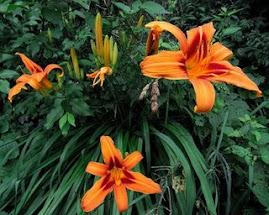
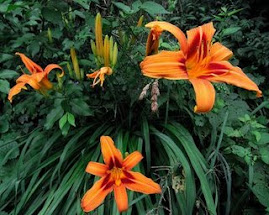
Over the years I have set various plants in this inhospitable world. The Canadian roses (Adelaide Hoodless and the Explorer rose Henry Hudson) barely hold on. However, the red leafed rose (rosa glaucous or rosa rubifolia) is doing well. Feverfew, which volunteers all over Port Arthur has muscled in among some spreading tough sedum. The geranium Johnson’s Blue has done surprisingly well. And nothing can kill the orange day lily. I also plant a few tiny yellow marigolds in clumps here and there. Last summer, I was surprised at how well a begonia, planted beside the rock, flourished, so more begonias this summer.
I put lots of good compost on these front beds and the maple roots love it and colonizes it before the summer is over. I love the maple tree very much but like all love, it comes at a price.
When I first bought the house, I planned to remove all the sod and turn the small patch into a non-lawn area of rocks, shrubs and artfully placed perennials such as iris and day lilies. I got the idea while walking around the older streets of Winnipeg. I bought a big stone from LCR Estates on Oliver Road and the plan was to make the stone the centrepiece. This plan died the first time I tried to remove some of the existing grass to make a garden. It was a chore just to get the trowel in the ground.
Over the years I have set various plants in this inhospitable world. The Canadian roses (Adelaide Hoodless and the Explorer rose Henry Hudson) barely hold on. However, the red leafed rose (rosa glaucous or rosa rubifolia) is doing well. Feverfew, which volunteers all over Port Arthur has muscled in among some spreading tough sedum. The geranium Johnson’s Blue has done surprisingly well. And nothing can kill the orange day lily. I also plant a few tiny yellow marigolds in clumps here and there. Last summer, I was surprised at how well a begonia, planted beside the rock, flourished, so more begonias this summer.
I put lots of good compost on these front beds and the maple roots love it and colonizes it before the summer is over. I love the maple tree very much but like all love, it comes at a price.
Wednesday, 6 February 2008
Gardners are Suckers
There is no doubt that gardeners are suckers for something new and exciting. Even though my T&T order was creeping close to the 200 dollar mark, (see list below) I fell in love with a tall grass described in Manitoba Gardener.
First let me explain that the Manitoba Gardener Magazine (available in the public library) is a good resource for Thunder Bay gardeners. I believe if a plant can survive winter in Winnipeg, it can survive in Thunder Bay.
The grass is called Calamagrostis x acutiflora or Karl Foerster. (or feather reed grass for the latin challenged.) The article hit all my weak spots with the use of the following words: over six feet tall, low maintenance, no staking, no over winter protection required, long living, does not spread by seed, a sure bet to please. Please! I’ll take it.
I grew a few ornamental grasses from seed a couple of years ago but they were insignificant squibs. I like drama in my tiny garden. A tall feathery waving thing at the back of the sun garden – what sounds better? T&T provides roots at $7.50 each and the article advises to plant in groups of five. Yikes! I’m considering spending 40 bucks for grass? Yes, I am. “A vertical masterpiece, “ says the catalogue. I melt.
I usually do not buy plants by mail order. I prefer to see the plant first and we have excellent nurseries here in Thunder Bay. As well, there are three or four reliable growers selling at Saturday morning yard sales. The few times I have bought plants by mail, Iplanted then in a pot first just to get them started away from the wild competition in the perennial beds. Once they come on strong, into the chosen spot they go. I will follow this procedure with the feather reed grass.
Speaking of money in the garden, the price of seeds is higher this year. Comparing this year’s and last year’s T&T and Stokes catalogue, I find increases of ten cents a pack here, thirty cents a pack there. I wonder why?
First let me explain that the Manitoba Gardener Magazine (available in the public library) is a good resource for Thunder Bay gardeners. I believe if a plant can survive winter in Winnipeg, it can survive in Thunder Bay.
The grass is called Calamagrostis x acutiflora or Karl Foerster. (or feather reed grass for the latin challenged.) The article hit all my weak spots with the use of the following words: over six feet tall, low maintenance, no staking, no over winter protection required, long living, does not spread by seed, a sure bet to please. Please! I’ll take it.
I grew a few ornamental grasses from seed a couple of years ago but they were insignificant squibs. I like drama in my tiny garden. A tall feathery waving thing at the back of the sun garden – what sounds better? T&T provides roots at $7.50 each and the article advises to plant in groups of five. Yikes! I’m considering spending 40 bucks for grass? Yes, I am. “A vertical masterpiece, “ says the catalogue. I melt.
I usually do not buy plants by mail order. I prefer to see the plant first and we have excellent nurseries here in Thunder Bay. As well, there are three or four reliable growers selling at Saturday morning yard sales. The few times I have bought plants by mail, Iplanted then in a pot first just to get them started away from the wild competition in the perennial beds. Once they come on strong, into the chosen spot they go. I will follow this procedure with the feather reed grass.
Speaking of money in the garden, the price of seeds is higher this year. Comparing this year’s and last year’s T&T and Stokes catalogue, I find increases of ten cents a pack here, thirty cents a pack there. I wonder why?
Tuesday, 5 February 2008
Tulips of Thunder Bay
TULIPS of THUNDER BAY
By Joan M. Baril
The snow bends over the garden. The garden hunches up into the snow. Below, in the frozen clods and crumbles of earth, the tulip bulbs are waiting. They are probably thinking, “This is so not Holland. There, we did not freeze to the core, there we loafed in the soft earth and waited for spring.”
But every tulip has a living heart, a heart determined not to give in, determined to wait out the confusing darkness, determined to endure the cold, unlike the cowardly crocus who are all, at this minute, pouting and giving up, sulkily deciding not to grow or considering a sparse and grudging turn on stage. But the tulip heart is steady and ready, and waits for the thaw.
And when it comes, they will spring into the green life, burst into their respective colours and wave to the sun.
Inside the bulb, deep in the heart, is a tiny bit of DNA which contains their entire history: the sunny stony slopes of Turkey, the slow world of design and change in the flat fields of Holland, the exhilarating days when a single bulb was worth a fortune on the Dutch stock market, the famine days of 1945 when the Dutch dug them up to eat and now, the calm days of owning the northern hemisphere in the spring.
A tulip is cyclical. It blooms, dies down, takes in sun and regrows, rests and cools and blooms again. It sends out odd sweet scents, licorice or honey or pale mown grass and entices bees and gives pleasure to the gardener. If a freak May storm should arrive and cover the buds with coats of clear frost, the tulips nod and smile for no harm will be done and the experience will be exhilarating. .
For a week or six, the tulips own the garden and get the music going. They bring in the perennials, the lilacs and the iris, and, just as the peonies fall apart and the lilies arrive and the delphiniums are gearing up, the tulips’ lips curl back and they open wide, wide to the air and, almost turning themselves inside out, they release their petals one by one. The tall thin leaves are all that remain and these fiddle for position, twist for the light until, one day, they slowly brown and droop away for the year. All the orchestra is in tune now and the gardener is tired of gardening and sits in the sun and lets the weeds grow if they dare. She makes a dozen cups of tea, chats with her friends and reads books. And the tulip bulbs, now fat and buttery, lie is the warm earth and contemplate another winter and another spring.
By Joan M. Baril
The snow bends over the garden. The garden hunches up into the snow. Below, in the frozen clods and crumbles of earth, the tulip bulbs are waiting. They are probably thinking, “This is so not Holland. There, we did not freeze to the core, there we loafed in the soft earth and waited for spring.”
But every tulip has a living heart, a heart determined not to give in, determined to wait out the confusing darkness, determined to endure the cold, unlike the cowardly crocus who are all, at this minute, pouting and giving up, sulkily deciding not to grow or considering a sparse and grudging turn on stage. But the tulip heart is steady and ready, and waits for the thaw.
And when it comes, they will spring into the green life, burst into their respective colours and wave to the sun.
Inside the bulb, deep in the heart, is a tiny bit of DNA which contains their entire history: the sunny stony slopes of Turkey, the slow world of design and change in the flat fields of Holland, the exhilarating days when a single bulb was worth a fortune on the Dutch stock market, the famine days of 1945 when the Dutch dug them up to eat and now, the calm days of owning the northern hemisphere in the spring.
A tulip is cyclical. It blooms, dies down, takes in sun and regrows, rests and cools and blooms again. It sends out odd sweet scents, licorice or honey or pale mown grass and entices bees and gives pleasure to the gardener. If a freak May storm should arrive and cover the buds with coats of clear frost, the tulips nod and smile for no harm will be done and the experience will be exhilarating. .
For a week or six, the tulips own the garden and get the music going. They bring in the perennials, the lilacs and the iris, and, just as the peonies fall apart and the lilies arrive and the delphiniums are gearing up, the tulips’ lips curl back and they open wide, wide to the air and, almost turning themselves inside out, they release their petals one by one. The tall thin leaves are all that remain and these fiddle for position, twist for the light until, one day, they slowly brown and droop away for the year. All the orchestra is in tune now and the gardener is tired of gardening and sits in the sun and lets the weeds grow if they dare. She makes a dozen cups of tea, chats with her friends and reads books. And the tulip bulbs, now fat and buttery, lie is the warm earth and contemplate another winter and another spring.
Monday, 28 January 2008
Veggie seeds
Vegetable seeds for my tiny veggie plot. Ordered from T&T of Winnipeg
1).Straight eight cucumbers – Tried and true
2) Raven Hybrid Zucchini – last year I planted zucchini among the annuals and it did not like it. A poor show of leaves and no fruit. This year it will have a proper spot.
3) Squash, acorn table king
4) Northern extra sweet corn
5) Kale – easiest stuff to grow and so tender, unlike that in the grocery stores.
No pumpkin this year. I still have a freezer full of it.
Non seeds
1) A super duper sprayer to defeat the caterpillars on the high bush cranberry
2) Safer’s BTK insecticide – the caterpillars are going down!
3) Safer’s slug and snail stuff – expensive but the hostas expect it.
1).Straight eight cucumbers – Tried and true
2) Raven Hybrid Zucchini – last year I planted zucchini among the annuals and it did not like it. A poor show of leaves and no fruit. This year it will have a proper spot.
3) Squash, acorn table king
4) Northern extra sweet corn
5) Kale – easiest stuff to grow and so tender, unlike that in the grocery stores.
No pumpkin this year. I still have a freezer full of it.
Non seeds
1) A super duper sprayer to defeat the caterpillars on the high bush cranberry
2) Safer’s BTK insecticide – the caterpillars are going down!
3) Safer’s slug and snail stuff – expensive but the hostas expect it.
Sunday, 27 January 2008
Seed order
January 28, 2008
Finally my first seed order is ready to go. I buy from T&T seeds in Winnipeg. They have a small but very reliable catalogue.
Here is the list:
Bulbs: Ten Orienpet lily bulbs of mixed colour. These lilies were so spectacular last summer that I cannot resist ordering them again even though I do not know if the ones under the snow have survived the winter. These lilies are a cross between oriental and trumpet lilies with wonderful fragrance and substance. I plan to put them in big containers by the fence on the patio. I will probably not start them inside but put them directly in the containers and surround with annuals such as the white wave petunias, the pink raspberry dianthus and some blue pansies. In September, when they finish blooming, I will transplant them into the garden.
Annual Seeds to start inside:
1. Canary Bird vine, the fastest annual vine. It will cover the shed in leaves in a few weeks and in August send out starry yellow flowers.
2. Mammoth sweet peas. I buy the mixed colours and plant in the back lane for cutting.
3. Easy wave petunias to put around the above lilies. These are the most expensive seeds at $10.95 for 20 seeds or 53 cents a seed. Still they are cheaper than buying the plants in the nursery. I love white petunias. They glow in the dark.
4. Lobelia Crystal palace – tried and true dark blue.
5. Glorious Gleam nasturtiums. T&T is not offering my usual variety, Jewel, so I am trying this one. I hate changes!
6. Lemon gem marigolds Tiny scented marigolds to fill the spaces around the perennials in my very dry front garden.
8. Silver Cup lavatera. In spite of the name, these flowers are pink. And fabulous. Can’t have too many. The white are nice but not as floriferous.
9. Impatiens Elfin, a mix of colours. For the shade garden. Among the ferns, primula and columbine.
10. Godetia, wonderful pink long blooming lovelies.
11. Germaniums – white and pink. This will be the first year I have grown geraniums inside from seed. If they work I will put them in pots on the patio.
12. Dianthus – always nice in pots.
13. Jubilee Gem bachelor buttons - the bluest of the blue. Gives the blue hit needed until the delphiniums wake up.
14, Nicotania, a new offering by T&T seeds. I trust this company enough to go along with something new. This is the five-foot tall old-fashioned variety which is grown for the scent rather than the blooms. I have a blank space behind the old peony and there the plants will go.
15. Hibiscus Luna – another experiment for the masochistic gardener but I can’t resist.
Note – T&T offers no tall cosmos in this catalogue. And no schizanthus. Schizanthus is so trickly to grow inside that perhaps it is not popular. I will order these on line from Stokes along with the tiny petunias and tiny pansies. They bloom before the begonias and so carry the bloom into mid summer. However, if it is a hot summer, they peter out and have to be pulled but the begonias can take over the window boxes on their own and round out the season. At least that’s the plan. But as ever in gardening, we will see…..
-------------------------------------
Finally my first seed order is ready to go. I buy from T&T seeds in Winnipeg. They have a small but very reliable catalogue.
Here is the list:
Bulbs: Ten Orienpet lily bulbs of mixed colour. These lilies were so spectacular last summer that I cannot resist ordering them again even though I do not know if the ones under the snow have survived the winter. These lilies are a cross between oriental and trumpet lilies with wonderful fragrance and substance. I plan to put them in big containers by the fence on the patio. I will probably not start them inside but put them directly in the containers and surround with annuals such as the white wave petunias, the pink raspberry dianthus and some blue pansies. In September, when they finish blooming, I will transplant them into the garden.
Annual Seeds to start inside:
1. Canary Bird vine, the fastest annual vine. It will cover the shed in leaves in a few weeks and in August send out starry yellow flowers.
2. Mammoth sweet peas. I buy the mixed colours and plant in the back lane for cutting.
3. Easy wave petunias to put around the above lilies. These are the most expensive seeds at $10.95 for 20 seeds or 53 cents a seed. Still they are cheaper than buying the plants in the nursery. I love white petunias. They glow in the dark.
4. Lobelia Crystal palace – tried and true dark blue.
5. Glorious Gleam nasturtiums. T&T is not offering my usual variety, Jewel, so I am trying this one. I hate changes!
6. Lemon gem marigolds Tiny scented marigolds to fill the spaces around the perennials in my very dry front garden.
8. Silver Cup lavatera. In spite of the name, these flowers are pink. And fabulous. Can’t have too many. The white are nice but not as floriferous.
9. Impatiens Elfin, a mix of colours. For the shade garden. Among the ferns, primula and columbine.
10. Godetia, wonderful pink long blooming lovelies.
11. Germaniums – white and pink. This will be the first year I have grown geraniums inside from seed. If they work I will put them in pots on the patio.
12. Dianthus – always nice in pots.
13. Jubilee Gem bachelor buttons - the bluest of the blue. Gives the blue hit needed until the delphiniums wake up.
14, Nicotania, a new offering by T&T seeds. I trust this company enough to go along with something new. This is the five-foot tall old-fashioned variety which is grown for the scent rather than the blooms. I have a blank space behind the old peony and there the plants will go.
15. Hibiscus Luna – another experiment for the masochistic gardener but I can’t resist.
Note – T&T offers no tall cosmos in this catalogue. And no schizanthus. Schizanthus is so trickly to grow inside that perhaps it is not popular. I will order these on line from Stokes along with the tiny petunias and tiny pansies. They bloom before the begonias and so carry the bloom into mid summer. However, if it is a hot summer, they peter out and have to be pulled but the begonias can take over the window boxes on their own and round out the season. At least that’s the plan. But as ever in gardening, we will see…..
-------------------------------------
Indoor bulbs
January 27, 2008. Two blue hyacinths are in bloom in the kitchen with three more in the porch working on it. The blue (Delph Blue) variety has the strongest scent. This is unlike most plants where white blooms have the strongest scent. The very dark pink hyacinth was a short bloomer. I prefer the blue. There are people who dislike the smell of hyacinth. They do take over a room and when you come in from outside, the scent greets you.
The tulips planted in December are still in the cold room. I see one bulb tip is covered with rot. The others seem OK. The roots are not showing yet at the bottom of the pot. I still have tulip bulbs in the fridge to be planted in mid February, an experiment to get spring flowers that can go outside during the day.
It has been a good year for indoor bulbs so far. The three amaryllis were wonderful, the white the most beautiful. They were all regular size (ie too tall) and long lasting. Last year I bought the dwarf amaryllis and although they did not threaten to topple, they were short blooming. I planted one amaryllis late and slowly, slowly it grows. Then it will make a sprint and it will appear to lengthen before one's eyes.
What I have learned about growing bulbs indoors.
1) When you bring them out of the cold room, they like a cool place to start to grow. This fall I set the temperature in the porch too high (19 C) and the bulbs dried out fast. Now at 15 C they are slow but happy.
2) Bulbs need lots of water. if they do not get enough the flower may be malformed. You have to check them every day once they are out of cold storage.
3) Crocus - a few in a pot - are lovely and make great gifts. I like crocus better in a pot than I do outside in the spring where they are very short lived. They bloom early, before you are sitting out in the garden., and so get overlooked.
4) Hyacinth like small pots. Cosy pots. They just make too much leaf in large pots. Best would be just a bit larger than 4 inch and smaller than 6 – if possible. I believe they are loners and prefer to be single.
5) Very large pots of tulips may look good in the stores but this arrangement has been created after the plants are up. Planting large pots of tulips means that they flop around and do not flower at the same time. 6 inch pots are the best with three bulbs to a pot.
6)King Alfred daffodils are really a tall plant with a small flower, to my surprise. I thought they would be larger. I have not yet found the best daffodil for forcing.
7) Putting bulbs under grow lights seems to have little effect
The tulips planted in December are still in the cold room. I see one bulb tip is covered with rot. The others seem OK. The roots are not showing yet at the bottom of the pot. I still have tulip bulbs in the fridge to be planted in mid February, an experiment to get spring flowers that can go outside during the day.
It has been a good year for indoor bulbs so far. The three amaryllis were wonderful, the white the most beautiful. They were all regular size (ie too tall) and long lasting. Last year I bought the dwarf amaryllis and although they did not threaten to topple, they were short blooming. I planted one amaryllis late and slowly, slowly it grows. Then it will make a sprint and it will appear to lengthen before one's eyes.
What I have learned about growing bulbs indoors.
1) When you bring them out of the cold room, they like a cool place to start to grow. This fall I set the temperature in the porch too high (19 C) and the bulbs dried out fast. Now at 15 C they are slow but happy.
2) Bulbs need lots of water. if they do not get enough the flower may be malformed. You have to check them every day once they are out of cold storage.
3) Crocus - a few in a pot - are lovely and make great gifts. I like crocus better in a pot than I do outside in the spring where they are very short lived. They bloom early, before you are sitting out in the garden., and so get overlooked.
4) Hyacinth like small pots. Cosy pots. They just make too much leaf in large pots. Best would be just a bit larger than 4 inch and smaller than 6 – if possible. I believe they are loners and prefer to be single.
5) Very large pots of tulips may look good in the stores but this arrangement has been created after the plants are up. Planting large pots of tulips means that they flop around and do not flower at the same time. 6 inch pots are the best with three bulbs to a pot.
6)King Alfred daffodils are really a tall plant with a small flower, to my surprise. I thought they would be larger. I have not yet found the best daffodil for forcing.
7) Putting bulbs under grow lights seems to have little effect
Thursday, 24 January 2008
Welcome to Garden Thunder Bay
Right now we are ordering seeds, making plans and setting up lights to grow plants. If you want information and advice about how to garden in Thunder Bay, seek no further.
Subscribe to:
Posts (Atom)